Geometric Series Worksheet with Answers and Printable PDF
Twenty finite, infinite, shifted-index, decimal, modeling, and error-analysis problems.
What is included
Practice geometric sequences and series with complete HTML solutions and separate student and key PDFs.
Skills assessed
- common ratio
- finite sums
- infinite sums
- index shifts
- applied models
Prerequisites
- sequences
- sigma notation
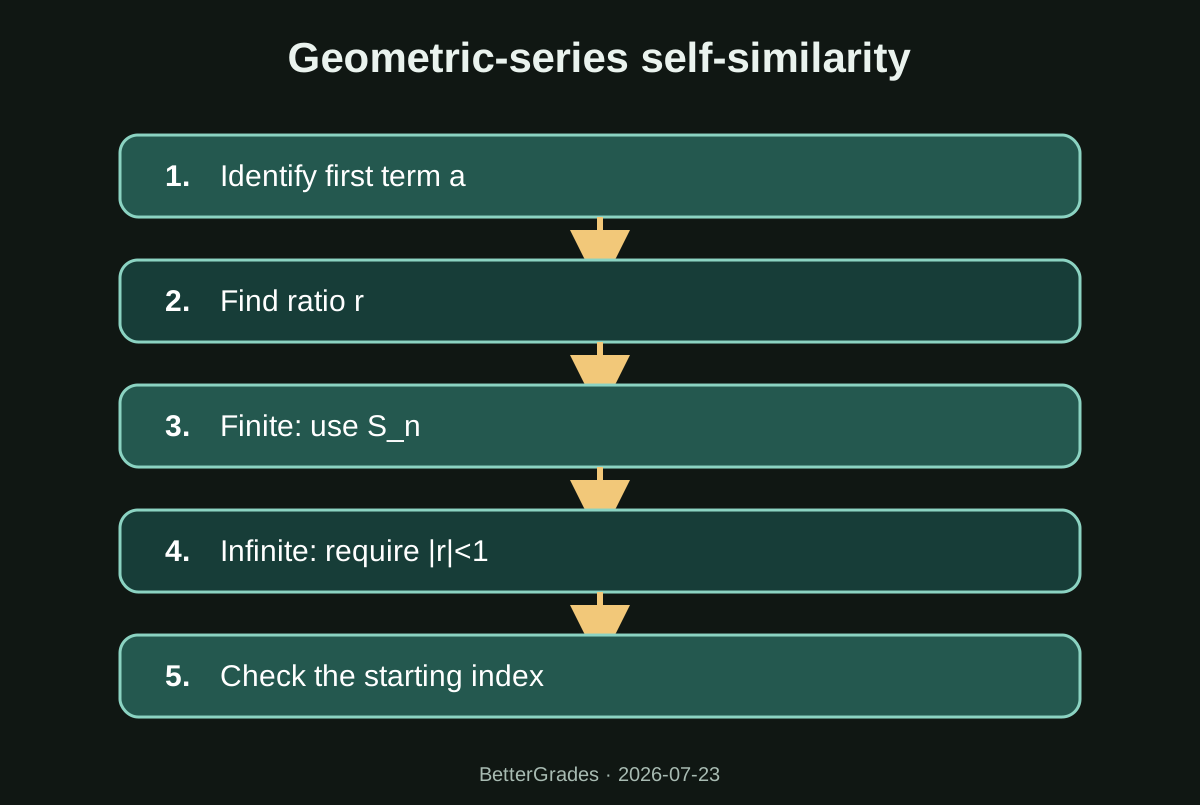
Long description
Read the diagram from top to bottom. Each numbered box names one decision or mathematical operation. Arrows show the required order; the text labels remain the complete interpretation in print, dark mode, and nonvisual reading.
Download this resource
No email address or account is required.
Ready for an honest first attempt?
This control sends only the resource id and type—never your answers or identity.
Printable preview
- Find the common ratio of 3, 12, 48, …
- Find a_8 when a_1=5 and r=2.
- Evaluate .
- Evaluate .
- Evaluate .
- Evaluate .
- Decide whether converges.
- Evaluate .
- Rewrite in form and sum it.
- Write 0.333… as a fraction.
- Write 0.272727… as a fraction.
- Write 0.145145… as a fraction.
- A ball rebounds 70% of each previous height after a 10 m drop. Find total vertical distance.
- Deposit 100 dollars at the end of each year for four years at 5 percent. Find the value immediately after the fourth deposit.
- A square has area 1; each stage shades one fourth of the remaining area. Find total shaded area.
- Find S_n for 7+7(0.8)+7(0.8)^2+…
- An infinite geometric series has first term 6 and sum 15. Find r.
- An infinite geometric series has ratio -1/4 and sum 8. Find its first term.
- A student uses a/(1-r) for r=2. Diagnose the error.
- Evaluate .
Complete worked solutions
Every problem has a source-matched answer and independently reviewed derivation.
Problem 1: Find the common ratio of 3, 12, 48, …
Answer:
Why this method: Geometric-series structure matches the mathematical structure before any algebraic cleanup.
- Divide either term by its predecessor: and .
- The constant quotient is .
Problem 2: Find a_8 when a_1=5 and r=2.
Answer:
Why this method: Geometric-series structure matches the mathematical structure before any algebraic cleanup.
- Use .
- Thus .
- Therefore the result is .
Problem 3: Evaluate .
Answer:
Why this method: Geometric-series structure matches the mathematical structure before any algebraic cleanup.
- There are six terms with first term and ratio .
- Using gives .
Problem 4: Evaluate .
Answer:
Why this method: Geometric-series structure matches the mathematical structure before any algebraic cleanup.
- There are five terms with first term and ratio .
- Using gives .
Problem 5: Evaluate .
Answer:
Why this method: Geometric-series structure matches the mathematical structure before any algebraic cleanup.
- Here , , and .
- Therefore .
- Therefore the result is .
Problem 6: Evaluate .
Answer:
Why this method: Geometric-series structure matches the mathematical structure before any algebraic cleanup.
- Here , , and .
- Therefore .
- Therefore the result is .
Problem 7: Decide whether converges.
Answer:
Why this method: Geometric-series structure matches the mathematical structure before any algebraic cleanup.
- The common ratio is , so .
- Its terms do not approach zero, and the infinite geometric series diverges.
- Therefore the result is .
Problem 8: Evaluate .
Answer:
Why this method: Geometric-series structure matches the mathematical structure before any algebraic cleanup.
- The first included term is , not .
- With ratio , the sum is .
- Therefore the result is .
Problem 9: Rewrite in form and sum it.
Answer:
Why this method: Geometric-series structure matches the mathematical structure before any algebraic cleanup.
- At the first term is , and each next term is multiplied by .
- Thus the series is , whose sum is .
- Therefore the result is .
Problem 10: Write 0.333… as a fraction.
Answer:
Why this method: Geometric-series structure matches the mathematical structure before any algebraic cleanup.
- Write the decimal as .
- This has , , so its sum is .
- Therefore the result is .
Problem 11: Write 0.272727… as a fraction.
Answer:
Why this method: Geometric-series structure matches the mathematical structure before any algebraic cleanup.
- Write the decimal as .
- This has , , so its sum is .
- Therefore the result is .
Problem 12: Write 0.145145… as a fraction.
Answer:
Why this method: Geometric-series structure matches the mathematical structure before any algebraic cleanup.
- Write the decimal as .
- This has ratio , so its sum is .
Problem 13: A ball rebounds 70% of each previous height after a 10 m drop. Find total vertical distance.
Answer:
Why this method: Geometric-series structure matches the mathematical structure before any algebraic cleanup.
- The initial drop contributes m; each rebound height is traveled once up and once down.
- Thus .
- Therefore the result is .
Problem 14: Deposit 100 dollars at the end of each year for four years at 5 percent. Find the value immediately after the fourth deposit.
Answer:
Why this method: Geometric-series structure matches the mathematical structure before any algebraic cleanup.
- Immediately after the fourth deposit, the four deposits have grown for three, two, one, and zero years.
- The value is , or dollars to the nearest cent.
- Therefore the result is .
Problem 15: A square has area 1; each stage shades one fourth of the remaining area. Find total shaded area.
Answer:
Why this method: Geometric-series structure matches the mathematical structure before any algebraic cleanup.
- The shaded areas are .
- Their sum is .
- Therefore the result is .
Problem 16: Find S_n for 7+7(0.8)+7(0.8)^2+…
Answer:
Why this method: Geometric-series structure matches the mathematical structure before any algebraic cleanup.
- The first term is , the ratio is , and the first terms end at exponent .
- Therefore .
- Therefore the result is .
Problem 17: An infinite geometric series has first term 6 and sum 15. Find r.
Answer:
Why this method: Geometric-series structure matches the mathematical structure before any algebraic cleanup.
- Use .
- Then , so , which satisfies .
- Therefore the result is .
Problem 18: An infinite geometric series has ratio -1/4 and sum 8. Find its first term.
Answer:
Why this method: Geometric-series structure matches the mathematical structure before any algebraic cleanup.
- Use .
- Thus .
- Therefore the result is .
Problem 19: A student uses a/(1-r) for r=2. Diagnose the error.
Answer:
Why this method: Geometric-series structure matches the mathematical structure before any algebraic cleanup.
- The formula requires .
- For , the terms do not approach zero, so the infinite series diverges.
- Therefore the result is .
Problem 20: Evaluate .
Answer:
Why this method: Geometric-series structure matches the mathematical structure before any algebraic cleanup.
- At the first term is ; there are five terms through , with ratio .
- Thus .
- Therefore the result is .
Common errors
- Using the infinite formula when |r|≥1.
- Mistaking the first listed term for the coefficient a after an index shift.
- Forgetting that a repeating-decimal series begins at a decimal place.