Finite Geometric Sum: Worked Example and Solution
A complete geometric-series structure example with method choice, derivation, verification, and a common wrong approach.
1 problem8 min estimated timeFoundational to intermediate progression
Problem
- Evaluate .
Complete worked solutions
Every problem has a source-matched answer and independently reviewed derivation.
01
Problem 1: Evaluate .
Answer:
Why this method: Geometric-series structure matches the mathematical structure before any algebraic cleanup.
- There are six terms with first term and ratio .
- Using gives .
What is included
See a concise answer and full derivation for evaluate sum from k equals 0 to 5 3 (2) to the power (k).
Skills assessed
- Geometric-series structure
Prerequisites
- sequences
- sigma notation
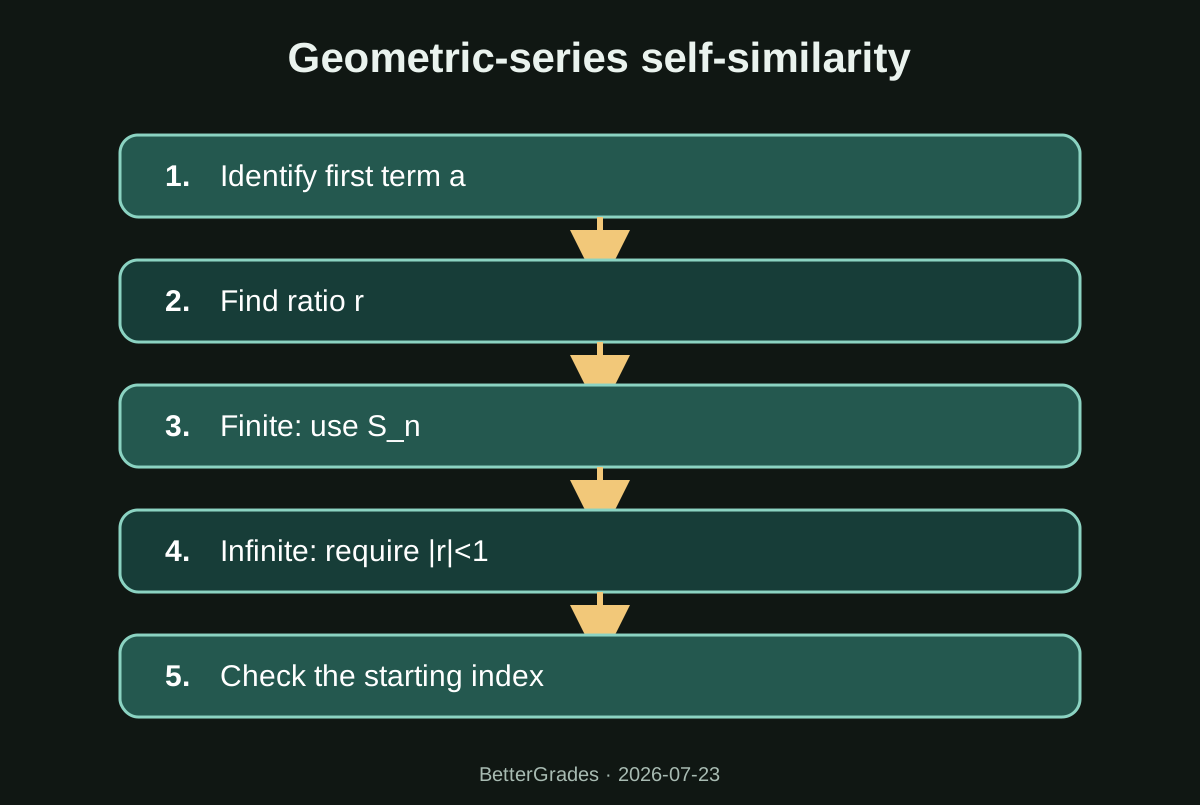
Long description
Read the diagram from top to bottom. Each numbered box names one decision or mathematical operation. Arrows show the required order; the text labels remain the complete interpretation in print, dark mode, and nonvisual reading.
Printable and accessible
Download this resource
No email address or account is required.
Common errors
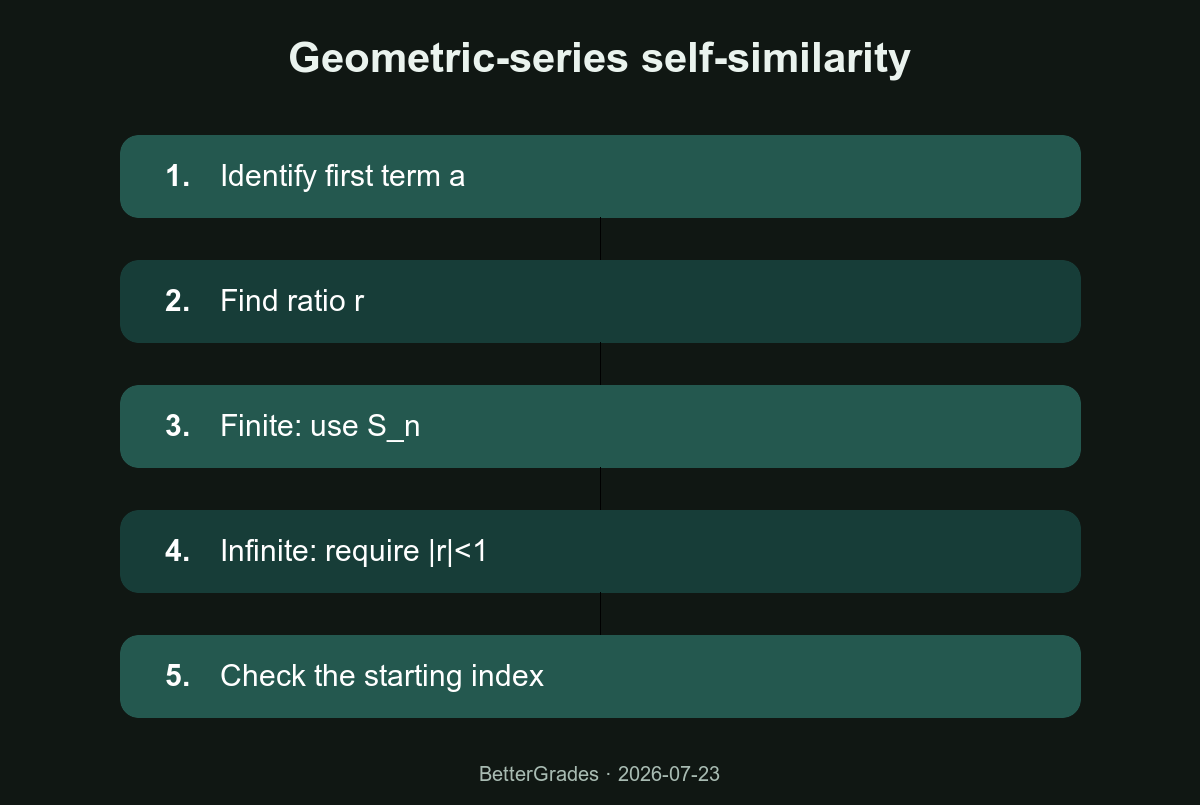
- Using the infinite-sum formula without checking the common-ratio condition or the starting index.