Taylor Series Worksheet with Answers and Error Practice
Twenty problems on known series, transformations, coefficients, intervals, approximations, and error.
What is included
Practice Maclaurin and Taylor series with complete solutions, interval checks, and error estimates.
Skills assessed
- series construction
- known-series transformations
- intervals of convergence
- remainder estimates
Prerequisites
- derivatives
- infinite series
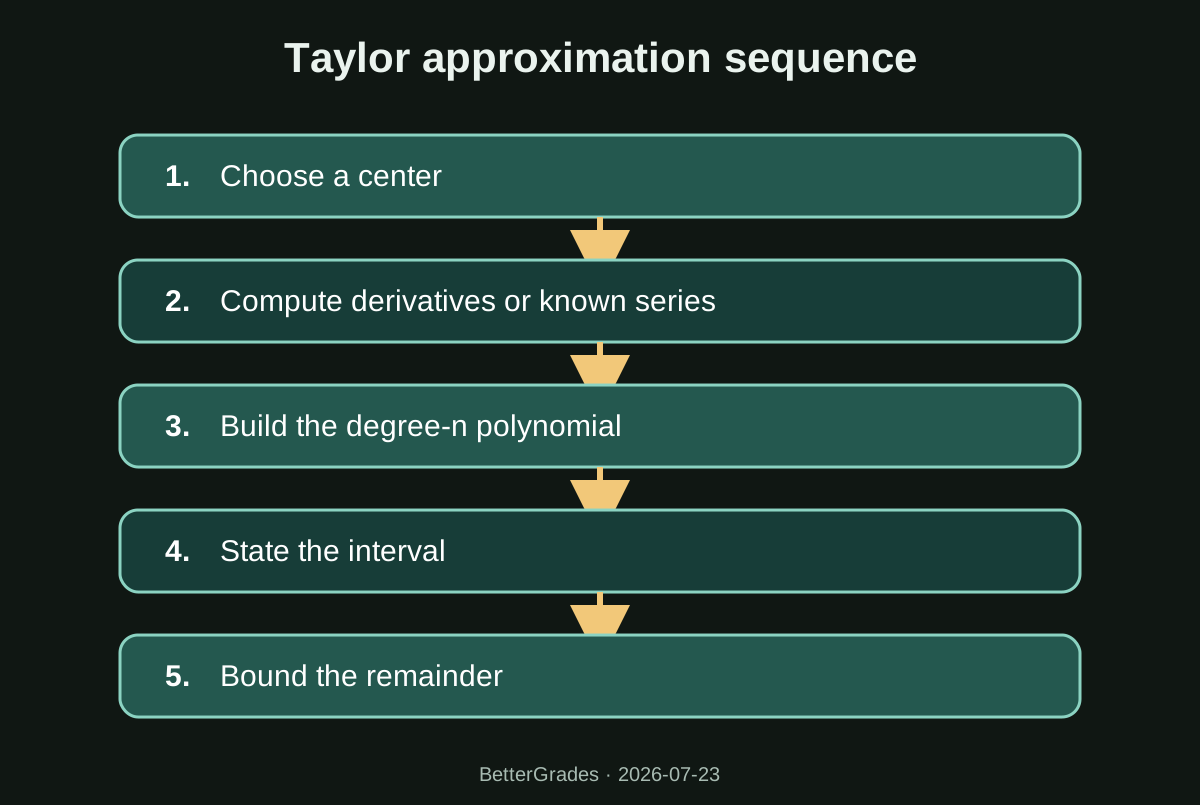
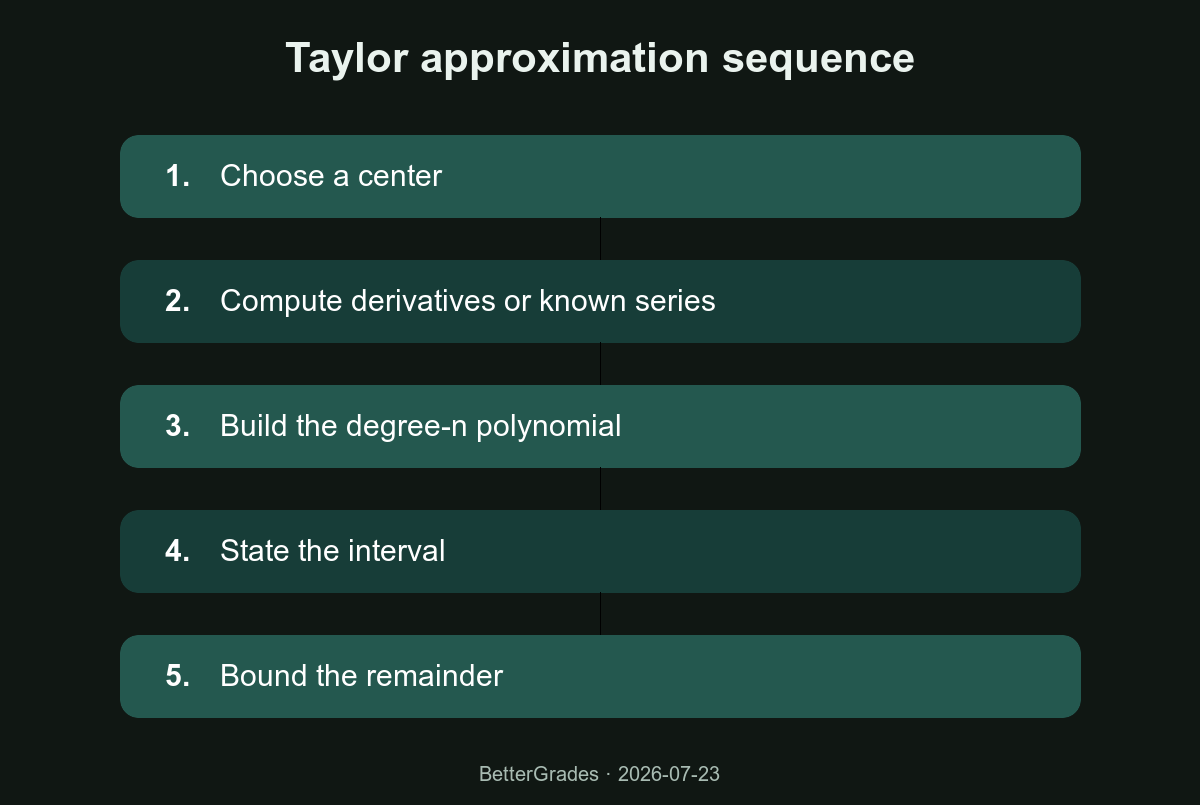
Long description
Read the diagram from top to bottom. Each numbered box names one decision or mathematical operation. Arrows show the required order; the text labels remain the complete interpretation in print, dark mode, and nonvisual reading.
Download this resource
No email address or account is required.
Ready for an honest first attempt?
This control sends only the resource id and type—never your answers or identity.
Printable preview
- Find the degree-3 Maclaurin polynomial for e^x.
- Find the degree-5 Maclaurin polynomial for sin x.
- Find the degree-4 Maclaurin polynomial for cos x.
- Write the first four nonzero terms of ln(1+x).
- Expand 1/(1-x) as a power series.
- Expand 1/(1+x^2) as a power series.
- Expand 1/(1-3x) as a power series.
- Find a power series for 1/(1-x)^2.
- Find a power series for arctan x by integrating 1/(1+x²), and state its interval of convergence.
- Find the degree-2 Taylor polynomial for ln x centered at 1.
- Write the Taylor series for e^x centered at a.
- If f^(n)(0)=2^n, find the Maclaurin series.
- Use T_3 for e^x to approximate e^{0.1}.
- Use x-x³/6 to approximate sin(0.2).
- Find the radius of .
- Find the interval of convergence of .
- Find the interval of convergence of .
- Find R for .
- Bound the error of the degree-3 Maclaurin approximation to e^{0.2}.
- How many terms of the alternating arctan series ensure error below 0.001 at x=1/2?
Complete worked solutions
Every problem has a source-matched answer and independently reviewed derivation.
Problem 1: Find the degree-3 Maclaurin polynomial for e^x.
Answer:
Why this method: Taylor or power-series construction matches the mathematical structure before any algebraic cleanup.
- Use .
- Retaining degrees 0 through 3 gives .
Problem 2: Find the degree-5 Maclaurin polynomial for sin x.
Answer:
Why this method: Taylor or power-series construction matches the mathematical structure before any algebraic cleanup.
- Use .
- Retaining terms through degree 5 gives .
Problem 3: Find the degree-4 Maclaurin polynomial for cos x.
Answer:
Why this method: Taylor or power-series construction matches the mathematical structure before any algebraic cleanup.
- Use .
- Retaining terms through degree 4 gives .
Problem 4: Write the first four nonzero terms of ln(1+x).
Answer:
Why this method: Taylor or power-series construction matches the mathematical structure before any algebraic cleanup.
- Integrate the geometric series for term by term.
- The first four nonzero terms are .
Problem 5: Expand 1/(1-x) as a power series.
Answer:
Why this method: Taylor or power-series construction matches the mathematical structure before any algebraic cleanup.
- The geometric identity requires .
- Set to obtain for .
- Therefore the result is .
Problem 6: Expand 1/(1+x^2) as a power series.
Answer:
Why this method: Taylor or power-series construction matches the mathematical structure before any algebraic cleanup.
- Set in the geometric series.
- This gives , with .
- Therefore the result is .
Problem 7: Expand 1/(1-3x) as a power series.
Answer:
Why this method: Taylor or power-series construction matches the mathematical structure before any algebraic cleanup.
- Set in the geometric series.
- The condition gives .
- Therefore the result is .
Problem 8: Find a power series for 1/(1-x)^2.
Answer:
Why this method: Taylor or power-series construction matches the mathematical structure before any algebraic cleanup.
- Differentiate term by term.
- This gives for .
- Therefore the result is .
Problem 9: Find a power series for arctan x by integrating 1/(1+x²), and state its interval of convergence.
Answer:
Why this method: Taylor or power-series construction matches the mathematical structure before any algebraic cleanup.
- Integrate from 0 to .
- The result is ; direct endpoint tests include both and .
- Therefore the result is .
Problem 10: Find the degree-2 Taylor polynomial for ln x centered at 1.
Answer:
Why this method: Taylor or power-series construction matches the mathematical structure before any algebraic cleanup.
- For , , , and .
- Substitution in the degree-2 Taylor formula gives .
Problem 11: Write the Taylor series for e^x centered at a.
Answer:
Why this method: Taylor or power-series construction matches the mathematical structure before any algebraic cleanup.
- Every derivative of equals , so .
- The Taylor formula gives , convergent for every real .
Problem 12: If f^(n)(0)=2^n, find the Maclaurin series.
Answer:
Why this method: Taylor or power-series construction matches the mathematical structure before any algebraic cleanup.
- The Maclaurin coefficient is .
- Thus the series is .
Problem 13: Use T_3 for e^x to approximate e^{0.1}.
Answer:
Why this method: Taylor or power-series construction matches the mathematical structure before any algebraic cleanup.
- Evaluate .
- The result is .
Problem 14: Use x-x³/6 to approximate sin(0.2).
Answer:
Why this method: Taylor or power-series construction matches the mathematical structure before any algebraic cleanup.
- Evaluate .
- The result is .
Problem 15: Find the radius of .
Answer:
Why this method: Taylor or power-series construction matches the mathematical structure before any algebraic cleanup.
- The ratio of successive absolute terms approaches .
- Convergence requires , so .
Problem 16: Find the interval of convergence of .
Answer:
Why this method: Taylor or power-series construction matches the mathematical structure before any algebraic cleanup.
- The radius is 1. At the harmonic series diverges; at the alternating harmonic series converges.
- Therefore the interval is .
Problem 17: Find the interval of convergence of .
Answer:
Why this method: Taylor or power-series construction matches the mathematical structure before any algebraic cleanup.
- The ratio test gives , hence .
- At the series is alternating harmonic and converges; at it is harmonic and diverges, giving .
Problem 18: Find R for .
Answer:
Why this method: Taylor or power-series construction matches the mathematical structure before any algebraic cleanup.
- The coefficient ratio satisfies .
- This tends to infinity, so .
Problem 19: Bound the error of the degree-3 Maclaurin approximation to e^{0.2}.
Answer:
Why this method: Taylor or power-series construction matches the mathematical structure before any algebraic cleanup.
- Taylor's theorem gives on .
- The bound is approximately .
- Therefore the result is .
Problem 20: How many terms of the alternating arctan series ensure error below 0.001 at x=1/2?
Answer:
Why this method: Taylor or power-series construction matches the mathematical structure before any algebraic cleanup.
- After terms, the alternating-series error is at most .
- Three terms give about , while four give about , so four terms are required.
- Therefore the result is .
Common errors
- Dropping factorials in coefficient formulas.
- Transforming a series without its convergence interval.
- Using an error estimate without checking its hypotheses.